
- Complete Security, Delivered with Accountability/
- Security Insights & Advisories/
- Cloud Misconfiguration: The APAC Risk Hiding in Plain Sight/
Cloud Misconfiguration: The APAC Risk Hiding in Plain Sight
Table of Contents
The cloud rewards speed. A team can stand up an entire production environment in an afternoon: compute, storage, databases, load balancers, all from a CLI or a Terraform file. That same speed applies to mistakes. A storage bucket made public for a demo and never reverted, a security group opened to 0.0.0.0/0 to “fix” a connectivity issue before a deadline, an admin credential pasted into a Slack channel: each of these takes seconds, and each can expose an entire business.
That is the core asymmetry of cloud security. On-premises, a mistake usually affects one server inside one network. In the cloud, a single setting is often globally reachable by default, and there are automated scanners on every continent looking for exactly those settings around the clock. Attackers do not break in anymore, as the saying goes: they log in, using a door somebody left open without realising it.
Why misconfiguration dominates cloud incidents #
Study the public breach record and a pattern emerges. The majority of cloud data exposures are not the result of novel exploitation. They are the result of known, documented settings that were left unsafe:
- Object storage exposed publicly. Buckets holding customer records, backups, or database dumps, open to the internet because of a single flag.
- Over-permissive IAM. Policies like
Action: "*"onResource: "*", granted for convenience during a project and never narrowed afterwards. - Management consoles reachable from anywhere. No IP restriction, no MFA enforcement, credentials that work from any country.
- Unencrypted data stores. Snapshots and volumes readable by anyone who obtains the identifier.
- Secrets in code. API keys committed to repositories, where automated scrapers find them within minutes.
None of these require sophistication to exploit. All of them require only ordinary attention to prevent. That is precisely why they matter: they sit in the gap between what the platform documents and what busy engineering teams have time to check.
You cannot fix what you cannot see #
The first honest step in most engagements is acknowledging how large the surface actually is. A mid-sized organisation routinely has thousands of cloud resources spread across accounts, regions, and subscriptions, accumulated by different teams over years. Nobody holds the full picture in their head, and spreadsheets go stale within weeks of being written.
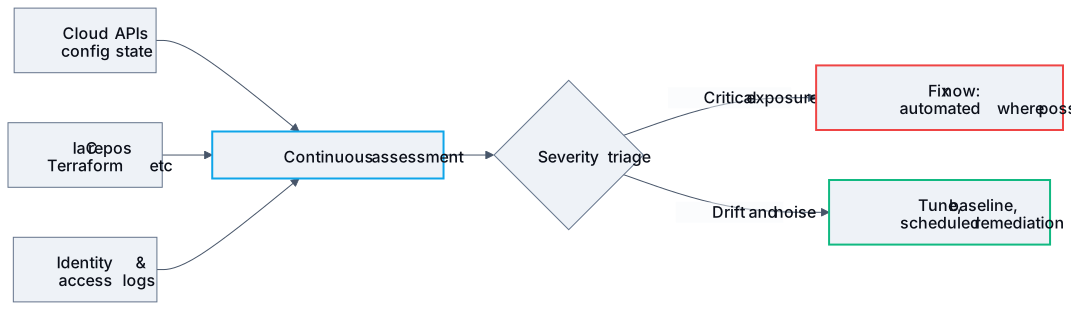
This is where continuous monitoring earns its place. The principle is simple: treat configuration state the way you treat application health, as something observed continuously rather than audited annually.
CSPM: useful tooling, with caveats #
Cloud Security Posture Management tools exist to automate that observation. They compare your live configuration against benchmarks such as the CIS Foundations Benchmarks and vendor security best-practice frameworks, then raise findings with severity ratings. Every major cloud now ships a native option (AWS Security Hub, Azure Secure Score, Google Security Command Centre), and third-party tools add multi-cloud coverage and deeper context.
Used well, they are genuinely valuable. Used naively, they produce a different problem: a findings queue so long that teams stop reading it. Three habits separate the two outcomes:
- Start with internet-facing exposure. Public storage, open management ports, and unauthenticated services come first. These are the findings that become incidents this week, not someday.
- Fix the source, not just the resource. If a finding is remediated by hand but the Terraform module still creates it insecurely, you have bought yourself one cleanup cycle. Change the module, and the finding disappears permanently everywhere it is used.
- Tune relentlessly. Suppress findings that do not apply to your architecture with a written justification. A queue containing only findings someone will act on is worth more than a complete queue nobody reads.
Note what CSPM does not do: it observes, it does not enforce. Guardrails such as service control policies that deny public buckets outright, or org-wide policies that block region sprawl, prevent the mistake at creation time. The strongest programmes combine both: guardrails for the known-bad, monitoring for everything else.
The best control is an educated engineer #
Every technical layer above ultimately depends on people understanding why the setting matters. An engineer who understands that object storage ACLs are independent of network routing will pause before making a bucket world-readable for a quick demo. One who has never been shown will click through.
Practical steps that fit real engineering culture:
- Make the secure path the easy path. Golden Terraform modules, pre-approved architecture patterns, and internal modules with encryption and logging enabled by default beat any amount of policy documentation.
- Run short, hands-on sessions. Ninety minutes with your own environment, reviewing your own CSPM findings together, teaches more than a day of generic cloud security slides.
- Blameless post-mortems for near misses. The exposed bucket caught by a colleague before attackers found it is a free lesson. Write it down, share it widely, and change the module that allowed it.
- Bring engineers into scoping conversations early. When security review happens at design time, it costs hours. When it happens after launch, it costs rework.
Admin education is not a soft alternative to tooling: it is the multiplier on every other control you buy.
Where to start this quarter #
If you take one thing from this article: you do not need a platform transformation to reduce cloud misconfiguration risk materially. A realistic ninety-day sequence looks like this:
- Weeks 1 to 2: Enumerate every account, subscription, and project. Enable native posture tooling if it is off.
- Weeks 3 to 6: Triage and remediate all internet-facing exposure. This list is usually short and always valuable.
- Weeks 7 to 12: Fix the top recurring findings at source in IaC, add guardrails for the categories you want prevented outright, and run the first engineering education session against your own findings.
The organisations that avoid cloud incidents are rarely the ones with the most tooling. They are the ones whose engineers know what the settings mean, and whose pipelines make the safe choice the default choice.
If you want an outside set of eyes on your configuration, our Configuration & Architecture Assessment reviews your cloud estate against CIS benchmarks and your own architecture’s intent, or schedule an Engineering & Scoping Session to plan the remediation sequence with your team.