
- Complete Security, Delivered with Accountability/
- Security Insights & Advisories/
- Data Obfuscation Explained: Storage vs Presentation/
Data Obfuscation Explained: Storage vs Presentation
Table of Contents
Security discussions often treat data obfuscation as a single architectural checkbox. Technical specifications frequently state that sensitive values must be obscured, redacted, or transformed before reaching storage or third parties. Yet in practice, confusing where and how you obscure data creates serious security gaps or breaks everyday business workflows.
Data obfuscation is not one single technique. It is a family of practical and mathematical transformations designed for specific stages in your application: data at rest (storage) and data in presentation.
Applying a presentation-level control to stored data leaves databases vulnerable to simple extraction. Conversely, applying irreversible storage transformations to fields that customer support agents need to verify destroys operational usability.
For protecting information while moving across networks, see our companion guide on data in transit protection. Here, let us break down the primary obfuscation methods, how they work, where they belong in your stack, and how they protect data across storage and presentation.
The Core Lifecycle States: Storage vs Presentation #
Before choosing an obfuscation strategy, engineering teams need to separate what happens in the database from what happens on screen:
[Raw Sensitive Data]
       │
       ├──► Storage Pipeline      ──► [Data at Rest] (Databases, Backups, Caches, Object Stores)
       │
       └──► Presentation Pipeline ──► [Data in Presentation] (Web Portals, Support Dashboards, Logs)
- Data at Rest (Storage): The main threat is database compromise, backup theft, or unconstrained queries by privileged administrators. The goal is making sure that if storage is dumped or exfiltrated, bulk sensitive data cannot be read.
- Data in Presentation: The main threat is visual shoulder surfing, session hijacking, over-privileged internal staff, and leakage into monitoring tools. The goal is showing only the minimum characters necessary for a human to confirm identity or complete a task.
Understanding this distinction clarifies why masking a card number on a web page does nothing if the database behind it holds the full raw card number in plaintext.
The Obfuscation Spectrum: Mechanism Breakdown #
Let us evaluate the core obfuscation techniques from basic cleartext to cryptographic protection.
1. Plaintext / Cleartext #
Storing or presenting data in cleartext means applying zero transformation. The raw characters sit in storage or render on screen exactly as typed.
Input:                   admin_api_key_88492
Database Stored:         admin_api_key_88492
Screen Presentation:     admin_api_key_88492
- How it behaves: Readable by any system, database query, background log, or viewer.
- Protection provided: None.
- Appropriate role: Public or non-sensitive operational values (status flags, timestamps, public product names).
2. Encoding (e.g., Base64, Hex, URL Encoding) #
Encoding converts data from one format to another using a publicly known, reversible algorithm without any secret key.
Input:                   secret_token_123
Base64 Encoded:          c2VjcmV0X3Rva2VuXzEyMw==
Hex Encoded:             7365637265745f746f6b656e5f313233
- How it works: Encoding translates binary data into ASCII text so that protocols and web standards can transmit it without corrupting special characters.
- The common misconception: Teams sometimes treat Base64 as a layer of security. Because anyone can decode Base64 in a fraction of a second using free browser tools, it offers zero confidentiality.
- Protection provided: None. It is a formatting and compatibility tool, not a security control.
3. Masking & Redaction #
Masking replaces a portion of the sensitive characters with fixed placeholder characters (such as * or X). Under payment standards like PCI DSS, only up to the first 6 digits (the Bank Identification Number) and the last 4 digits are permitted for presentation, with all middle digits concealed.
Full PAN:                4532 0150 9876 1234
PCI DSS Mask:            4532 01XX XXXX 1234  (First 6, Last 4 visible)
Email Mask:              j***n@puresecurity.com
Phone Mask:              +66 88 *** 8600
- Static vs Dynamic Masking:
- Static Masking: Permanently overwrites real values in staging, QA, and analytics environments so developers work with safe test data.
- Dynamic Masking: Applied on the fly at the API gateway or backend query layer. The database stores the protected record, while unprivileged staff see masked output on screen.
- State suitability: Essential for Data in Presentation, support portals, receipts, and application logs.
- Watch out for low entropy: On short or predictable numbers (like credit cards or national ID numbers), masking leaves a very small guessing space. If masked values are paired with fast hashes, an attacker can search through the remaining hidden digits in seconds.
4. Truncation #
Truncation permanently discards specific segments of the sensitive data string, retaining only a small portion, specifically the last 4 digits for customer reference.
Full PAN:                4532 0150 9876 1234
Truncated PAN:           1234  (ONLY the last 4 digits retained)
- How it works: Unlike masking (which keeps the full length with asterisks), truncation drops the rest of the string permanently.
- PCI DSS relevance: PCI DSS Requirement 3.5 allows truncation for storing account numbers at rest, provided no other internal systems store the missing segments alongside it.
- State suitability: Highly effective for Data at Rest when financial reconciliation only requires matching the last 4 digits.
- Limitations: Irreversible. Once truncated, the original number is gone. If your application needs to charge the card again automatically in the future, truncation makes that impossible without asking the customer to re-enter their card.
5. Cryptographic Hashing #
Cryptographic hashing runs input data through a one-way mathematical function to produce a unique, fixed-length fingerprint.
Input:                   PureSecurityAuth
SHA-256 Hash:            8c09a80fa9e3903a453f7b233a010d8677c77742d45c66cb1e4cf7985392fe19
- One-way nature: You cannot reverse the output hash mathematically back into the original text.
- Deterministic lookup: The same input always generates the identical output hash, making it useful for exact-match database lookups.
- The bare hash risk: Standard algorithms like SHA-256 are built to run fast. For low-entropy data like credit cards, phone numbers, or national IDs, modern hardware can test billions of guesses every second. As explored in our analysis on hashing low entropy data, unsalted hashes of small inputs offer almost no real security.
Adding Salt (Per-Record Random Nonce) #
A salt is a unique, random value created for each record and combined with the input before hashing:
Hash = SHA256(Salt + Input)
Stored Record: { salt: "e4f8a912", hash: "8c09a80f..." }
- Benefit: Prevents attackers from using precomputed lookup tables (rainbow tables). Two users with the exact same input will have completely different hashes.
- Limitation: The salt is stored in the database next to the hash. If an attacker steals the database, they can still run targeted dictionary attacks against low-entropy values using fast GPU cracking tools.
Adding Pepper (Server-Side Secret Key) #
A pepper is a secret cryptographic key stored entirely outside the database, such as in a Hardware Security Module (HSM), AWS KMS, or dedicated secrets manager. The pepper is combined with the input and salt inside an HMAC function:
Hash = HMAC-SHA256(Key=Pepper, Data=Salt + Input)
- Benefit: Even if an attacker steals your whole database, they cannot run offline brute-force attacks because they do not have the pepper key stored in the external HSM.
- State suitability: Excellent for Data at Rest indexing and searchable database lookups.
6. Tokenisation #
Tokenisation swaps sensitive data for a non-sensitive surrogate value (a token) that has no mathematical connection to the original data.
Raw Card:                4532 0150 9876 1234
Surrogate Token:         tkn_live_8f3a9e21d044b78c
- How Vaulted Tokenisation works: The real data is saved in an isolated, hardened token vault (often backed by an HSM). Application databases only hold the surrogate token. When a transaction happens, the app sends the token to the vault, which proxies the request to the payment gateway.
- Scoping and Detokenisation Risk: Tokenisation is the standard strategy to shrink compliance scope. Under PCI DSS compliance, systems that store only tokens fall outside the Cardholder Data Environment (CDE). However, you must manage access to detokenisation strictly. If the ability to reverse or detokenise tokens is accessible from a broader environment (such as general office networks or internal admin tools), that entire network may be pulled straight back into the CDE scope.
- State suitability: Outstanding for Data at Rest and internal application workflows.
7. Encryption (Symmetric & Asymmetric) #
Encryption uses secret cryptographic keys to scramble plaintext into ciphertext and back again. Unlike one-way hashing, encryption is fully reversible for authorized systems holding the decryption key.
- Symmetric Encryption (AES-256-GCM): Uses a single shared key for both encryption and decryption. Very fast and ideal for database columns, file storage, and API payloads, as outlined in our guide on Bank of Thailand API payload encryption.
- Asymmetric Encryption (RSA, ECC): Uses a public key to encrypt and a private key to decrypt. Allows client browsers or mobile devices to encrypt sensitive data that only a protected backend service can unlock.
- Key management requirement: Encrypted data is only as secure as the keys protecting it. Decryption keys must be separated from database storage and managed using automated access policies and rotation.
Comparison Matrix: Obfuscation Methods #
The table below summarizes how each obfuscation method behaves, what data states it protects, and its core trade-offs:
| Obfuscation Method | Primary Target State | Reversibility | Protects Data at Rest or Presentation? | Main Benefits | Key Limitations & Pitfalls |
|---|---|---|---|---|---|
| Plaintext / Clear | Non-sensitive metadata | N/A (Original) | Neither | Zero processing overhead; instant readability | Zero security. Full exposure during any incident. |
| Encoding (Base64/Hex) | Format compatibility | Fully reversible (No key needed) | Neither | Resolves character encoding and data transport issues | Provides zero confidentiality. Often confused for encryption. |
| Masking (Static) | Test/QA storage | Irreversible (Real data removed) | Rest (in non-production environments) | Safely populates staging and dev systems with realistic data | Destroys live operational utility if applied to primary production databases. |
| Masking (Dynamic) | Presentation layer | Controlled (Masked on render) | Presentation (Rest requires separate protection) | Prevents shoulder surfing, screen capture leaks, and staff snooping | Backend database remains unprotected unless paired with storage encryption or tokens. |
| Truncation | Storage at rest | Irreversible (Middle/first digits deleted) | Rest & Presentation | Simple to use; zero cryptographic keys to manage | Permanent data loss. Cannot be used for recurring payments or automated chargebacks. |
| Fast Hashing (Bare SHA-256) | Integrity checking | Irreversible (One-way digest) | Neither (for low-entropy IC/ID or card data) | Fast computation; enables deterministic database indexes | Vulnerable to rainbow tables and fast GPU brute-force attacks on low-entropy values. |
| Salted Hash | Password storage | Irreversible (Per-record nonce) | Rest (slows mass dictionary attacks) | Defeats precomputed rainbow tables completely | Salt stored in database still permits targeted offline GPU cracking on short inputs. |
| Salted & Peppered Hash / HMAC | Searchable database indexing | Irreversible (Key held in external HSM) | Rest (prevents offline cracking without key) | Protects database dumps against offline dictionary attacks | Exact-match searches only; partial or wildcard searches are not supported. |
| Tokenisation (Vaulted / HSM) | Database storage | Reversible (Only via secure token vault) | Rest & Presentation (when token is shown) | Dramatically shrinks compliance scope; stolen tokens are useless | Exposing detokenisation APIs to internal office networks pulls those networks into audit scope. |
| Application Encryption (AES-GCM) | Database storage | Reversible (With authorized decryption key) | Rest (decrypted in memory before presentation) | Preserves complete original data; mathematically sound | Adds key lifecycle complexity (KMS management, key rotation, strict access controls). |
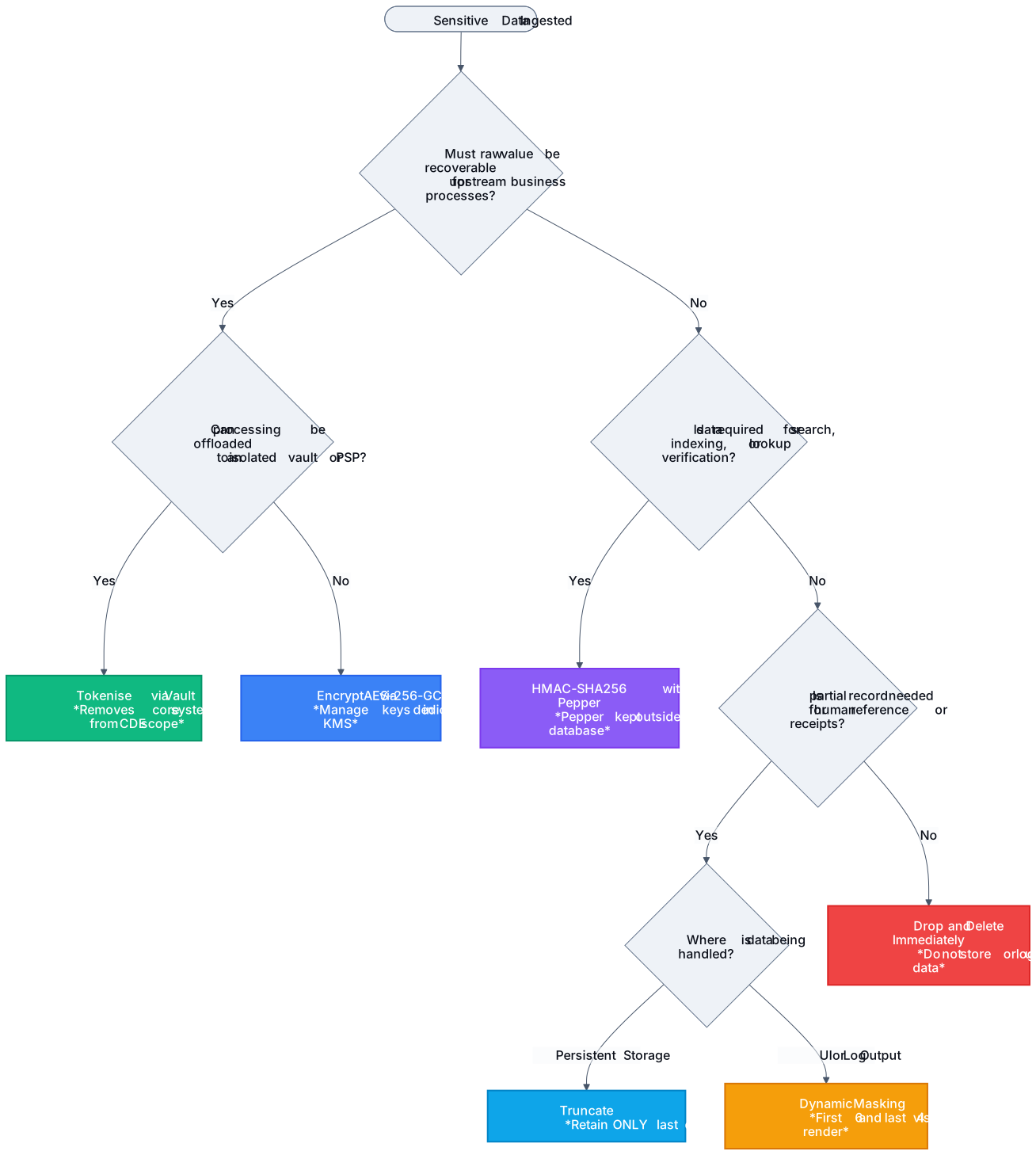
Architectural Decision Framework #
When determining which obfuscation or data protection technique to apply to a specific sensitive field, walk through this decision tree:
Key Takeaways #
- Minimise data first: The best way to protect data is not storing it at all. If an operational process does not strictly require a field, drop or delete it immediately.
- Never substitute presentation controls for storage security: Presenting asterisks on a web frontend does not protect an unencrypted database column from an SQL injection or backup leak.
- Protect low-entropy identifiers: If you must index credit card numbers, national IC/ID numbers, or phone numbers, avoid bare SHA-256 hashes. Use HMAC with a hardware-secured pepper or memory-hard hashing algorithms.
- Isolate your encryption keys: Keep cryptographic keys in dedicated KMS or HSM services with strict access controls. Storing encryption keys in the same database environment completely negates the control.
- Watch your detokenisation boundaries: While tokenisation drastically reduces compliance scope, allowing unsegmented office networks or general tools to detokenise data pulls those broader environments straight into regulatory scope.
Where to Go From Here #
- Assess your current scope: Run a PCI DSS Gap Assessment & Scope Reduction to identify unprotected sensitive data paths across your infrastructure.
- Audit your application APIs: Conduct an API & Application Security Review to ensure frontend masking matches backend tokenisation and payload encryption standards.
- Validate regulatory compliance: Review your data protection controls against APAC frameworks through our Regulatory Compliance Advisory.