
- Complete Security, Delivered with Accountability/
- Security Insights & Advisories/
- Network Segmentation Design: Cut Risk and Cost at Once/
Network Segmentation Design: Cut Risk and Cost at Once
Table of Contents
If I could choose exactly one architectural change for an organisation that wants to lower both its breach risk and its security costs, it would not be a new product or platform. It would be network segmentation. No other control I know reduces two of your biggest problems with the same money.
The reason is simple. Almost every expensive security problem shares one root cause: flat networks let small problems become large ones. Segmentation cuts that link. It contains what an attacker can reach after the first mistake, shrinks the systems your compliance frameworks care about, and turns an unmanageable sprawl into something a small team can actually understand.
Why flat networks fail quietly #
A flat network is one where most systems can talk to most other systems. It is how networks end up by default, because flatness is convenient: no firewall rules to negotiate when a new server needs a database, nothing to update when a developer’s laptop needs a test system.
The cost arrives later. Consider how real intrusions actually progress. The initial foothold is usually minor: a phished credential on a laptop, a vulnerable VPN appliance, a forgotten test server with an internet-facing management port. On its own, that foothold is worth little. What makes breaches expensive is lateral movement: from the first compromised machine, the attacker explores the network, harvests credentials, reaches servers that were never meant to be reachable from a user device, and escalates until they hold something valuable.
Flat networks make every step of that journey free. Segmented networks make every step cost the attacker visible effort, time, and noise. Penetration testers will tell you the difference is dramatic: in a flat environment we routinely go from one laptop to domain-wide compromise within days; against well-designed segments, the same engagement stalls at the first hop and stays there.
What segmentation buys you #
1. It limits initial breach impact #
When zones are separated by enforced boundaries, the compromise of a user workstation does not grant access to payment systems, domain controllers, or industrial controls. The attacker holds one segment, not the business. That is the difference between an incident you recover from in an afternoon and a breach announcement.
2. It stops lateral movement #
East-west traffic between workloads should be rare, purposeful, and observed. In most environments it is none of those things. Segmenting means an attacker who lands anywhere finds dead ends instead of open corridors, and the paths that must exist are narrow enough to monitor.
3. It shrinks compliance scope #
This is where the cost reduction becomes concrete. PCI DSS applies to the cardholder data environment (CDE) and everything connected to it. With proper segmentation, verified through penetration testing, the CDE might be a handful of systems instead of hundreds. Fewer in-scope systems means less evidence collection, fewer assessment hours, cheaper annual validation, and a smaller surface to keep patched and monitored. The same logic benefits ISO 27001 risk treatment and any regulator conversation about containment.
We have seen assessments halve in effort purely because a client completed a segmentation project beforehand. The segmentation work usually costs less than one year of the assessment savings it creates.
4. It makes the network manageable #
Perhaps the least appreciated benefit: segmented networks are knowable. When traffic flows are constrained to documented paths, anomalies stand out. A workload suddenly reaching a database server it never talks to is either an incident or a misconfiguration, and both deserve attention. In a flat network the same signal drowns in noise, because everything talks to everything all the time. Segmentation is what makes monitoring meaningful.
Design principles that hold up #
Good segmentation is architecture, not appliance shopping. The principles that matter:
Start from data, not boxes. Identify where sensitive data lives and flows: cardholder data, credentials, personal information, financial records. Zones form around what needs protection, not around whatever diagram existed last year.
Define tiers by trust and function. A practical baseline for most organisations:
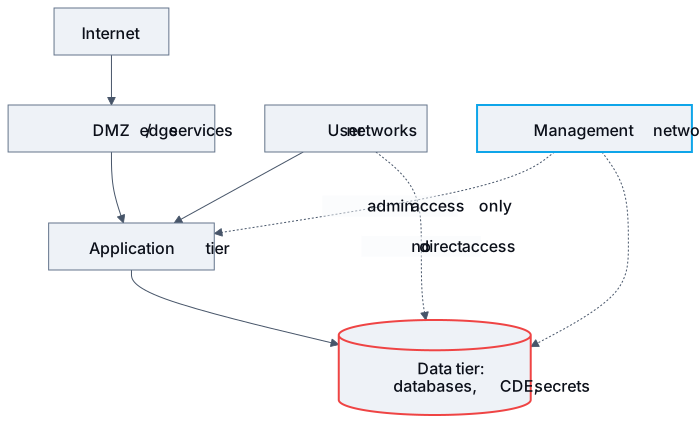
Internet-facing services, user devices, application tier, data tier, and an out-of-band management network. Each boundary has an explicit allow-list; everything else is denied.
Default deny, then add purposefully. Every permitted flow between zones should have an owner and a reason written down somewhere. If nobody can say why a rule exists, it is a finding waiting to be exploited.
Segment inside the cloud too. Security groups, VPCs, and service policies are segmentation; cloud platforms just implement it differently. The same discipline applies: production isolated from non-production, databases unreachable from the internet, admin planes on separate paths.
Test the segments, do not assume them. Segmentation only counts if it holds under attack. For PCI DSS specifically, the standard requires penetration testing that verifies isolation at least annually and after major changes. A penetration test that attempts lateral movement from each zone tells you whether your design works or merely looks good in a diagram.
A realistic path to get there #
Nobody re-architects a live network over a weekend. The sequence that works:
- Discover. Map actual traffic flows over several weeks. Real networks differ from their documentation everywhere, always.
- Declare. Define target zones and write down the flows that must cross each boundary. Get business sign-off on that list.
- Contain the crown jewels first. Fence off payment systems, domain infrastructure, and sensitive data stores before doing anything cosmetic.
- Migrate gradually. Move systems into zones in waves, starting with anything internet-facing. Fix breakage in low-stakes areas while lessons are cheap.
- Verify and maintain. Test boundaries annually, review rules quarterly, and treat any undocumented cross-zone flow as an incident until proven otherwise.
Most organisations reach a defensible baseline within one to two quarters of steady work, and the earlier phases pay for themselves immediately through reduced audit scope.
The bottom line #
Security spending usually involves a trade-off: reduce risk or reduce cost. Network segmentation is the standing exception. It caps the damage of the breach attempts that succeed, starves attackers of the lateral movement that makes incidents expensive, shrinks the scope of every framework you answer to, and produces a network your team can reason about. There is no second place worth arguing about.
Our Configuration & Architecture Assessment maps your real traffic flows and designs a segmentation roadmap your team can execute, and our penetration testing verifies the segments actually hold. Or schedule an Engineering & Scoping Session to talk through where to start.