
- Complete Security, Delivered with Accountability/
- Security Insights & Advisories/
- Open Source vs Commercial Security Tools in Thailand/
Open Source vs Commercial Security Tools in Thailand
Table of Contents
There is a quiet irony in enterprise security procurement: an organisation will pay a seven-figure licence for a “unified platform” that is, under the hood, a bundle of open source projects wrapped in a dashboard and a sales motion. The vendor did not invent the detection engine: the community did. You are paying for packaging.
That is not an argument against paying for software. It is an argument for knowing what you are buying, and for recognising that a small engineering team can often build a more effective, more bespoke security stack from open source components than it can licence from a vendor.
Bespoke solutions for a unique environment #
No two environments are alike, but commercial tools are built for the average one. They assume a network shape, a data centre topology, and a logging model that may not match your reality. The result is a tool that fits 80% of your environment and awkwardly leaves the other 20%, usually the parts that matter, to custom scripting anyway.
Open source inverts that relationship. You compose the stack to match your architecture, not the other way around. Runtime security with Falco, network visibility with Zeek, host intrusion detection with Wazuh, container scanning with Trivy, vulnerability automation with Nuclei, static analysis with Semgrep. Each component does one thing well, and they compose.
This is the Unix philosophy applied to security: small, sharp tools that communicate over standard interfaces, rather than one monolith that owns everything.
The tools talk to each other #
A vendor suite wants to be the centre of gravity. Everything must feed it, use its agent, speak its query language. That silo becomes a ceiling: the moment you need a signal it does not natively produce, you are stuck waiting on a roadmap.
Open source tools are built around open formats and APIs. Zeek emits JSON. Falco emits events to stdout. Wazuh ingests via its API. Because they communicate over open interfaces, you can route them all into the same pipeline, whether that is an OpenSearch cluster, a SIEM, or a plain log sink, and query the whole picture with one language.
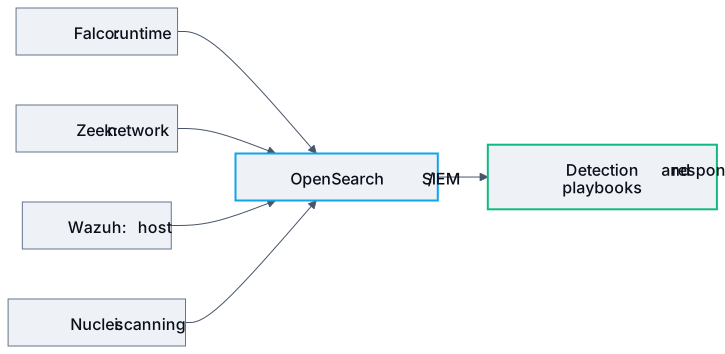
A commercial suite asks you to give up that composability. An open source stack makes it the default.
You invest in people, not licences #
A licence is a recurring cost that goes away the moment you stop paying, along with the capability. An open source stack is a recurring investment in your engineers, who learn the internals of the tools they operate.
That matters more than the line item. The engineer who has built the detection pipeline understands why an alert fired, can tune out a false positive without opening a support ticket, and can extend the tool when a new threat appears. Your organisation owns the capability; it does not rent it.
When a key engineer moves on, the project does not die with them. The tooling is version-controlled, documented, and reproducible, because open source work is, by nature, exposed to review. That is the same dynamic Eric S. Raymond described in The Cathedral and the Bazaar: many eyes on code make bugs shallow, and make knowledge transfer part of the process rather than an afterthought.
Beware the “we already sell that” trap #
Before you buy anything, look at what you already operate. A surprising number of organisations licence a commercial SIEM, a commercial scanner, and a commercial EDR, then discover their existing open source stack already produced 90% of the same signal for free.
The pattern repeats: a vendor sells a “solution” that is an orchestration layer over tools you could run yourself, with a UI and a support contract bolted on. That support contract has genuine value when you lack the people to operate the tool. But if you have the people, or want to build them, the open source path is usually cheaper and more effective.
When “buy” is still right #
This is not a blanket argument. Commercial tools win when:
- You have no one to operate the tool, and support is the product.
- The vendor genuinely owns proprietary detection content you cannot replicate.
- Regulatory attestation of the vendor itself (not just your use of it) is required.
The point is to make that decision deliberately, with your eyes open about what is under the hood, not to default to the licence.
If you want the composition done for you, our Configuration & Architecture Assessment reviews what you already run and maps a build-vs-buy path for the gaps, or schedule an Engineering & Scoping Session to design a bespoke stack around your environment.