
- Complete Security, Delivered with Accountability/
- Security Insights & Advisories/
- Post-Quantum Cryptography: Preparing for the Quantum Shift/
Post-Quantum Cryptography: Preparing for the Quantum Shift
Table of Contents
Every encrypted transaction across modern networks, from banking APIs and online logins to encrypted backups, rests on a foundational premise: cryptography does not need to protect a secret forever. It only needs to protect a secret until that data becomes completely worthless to an adversary.
When you set an account password or encrypt financial records, security engineers know that any mathematical lock can theoretically be broken given infinite computational power. Modern encryption works because of economic and temporal resistance. If guessing a 256-bit key takes classical supercomputers billions of years, the data is safe for all practical purposes. By the time an attacker could crack it, the credit card has expired, the bank account is closed, and the session has ended.
Quantum computing breaks this economic contract.
With quantum hardware advancing from physics laboratories into enterprise reality, regional institutions are raising alarms. In Southeast Asia, cyber authorities and industry leaders have warned that organisations must prepare for post-quantum risks immediately, as reported by the Bangkok Post.
You do not need a doctorate in quantum physics to protect your organisation. You need to understand how quantum machines differ from classical binary computers, why hostile actors are already intercepting encrypted traffic today, and what technical steps safeguard your business.
How Quantum Computing Differs from Classical Binary #
To understand why quantum computers disrupt encryption, consider how classical computers process numbers compared to quantum systems.
CLASSICAL COMPUTING (BINARY BITS)
- Basic Unit: Bit (Strictly 0 OR 1)
- Method: Tests combinations sequentially, one step at a time
- Analogy: An explorer walking through a maze, hitting dead ends until finding the exit

QUANTUM COMPUTING (QUBITS)
- Basic Unit: Qubit (Superposition: 0 AND 1 simultaneously)
- Method: Evaluates entire problem spaces at once using wave interference
- Analogy: Water flooding the entire maze, finding every open path in a single instant
The Classical Way: Counting One by One #
Classical computers run on bits. A bit is a physical switch that is either 0 (off) or 1 (on).
To crack an encryption key, a classical processor tests combinations one by one: 0000, 0001, 0002, and so on. While modern supercomputers test billions of values each second, they are still counting sequentially. When encryption uses 2048-bit RSA keys or 256-bit elliptic curves, the possible combinations exceed the number of atoms in the observable universe. Classical computers cannot factor these numbers within any human lifespan.
The Quantum Way: All States at Once #
Quantum computers manipulate subatomic particles to create qubits. A qubit operates under two physical principles:
- Superposition: Unlike a classical bit that is strictly
0or1, a qubit represents0and1simultaneously. While 50 classical bits hold one 50-digit number at any given microsecond, 50 qubits hold all 1,000,000,000,000,000+ configurations at once. - Quantum Interference: Instead of checking paths sequentially, a quantum system sets up wave equations where incorrect paths cancel each other out, amplifying the single correct answer.
Think of a complex maze. A classical computer walks down one path at a time. A quantum computer acts like water flooding the entire maze, reaching the exit in a single instant.
Because of this property, a quantum algorithm called Shor’s Algorithm can calculate the prime factors behind RSA and solve the discrete logarithms behind ECC in hours, dissolving the asymmetric locks protecting modern digital systems.
The Breakthroughs: How Close Are We? #
Quantum computing is no longer a distant theoretical concept. Progress has shifted into rapid hardware and software engineering:
THE PATHWAY TO QUANTUM THREAT (CRQC)

[Lab Proofs] ───────────> [Physical Scaling] ────> [Error Correction] ────> [CRQC Threat]
Proving quantum physics   Building 1,000+ noisy   Combining physical qubits  Machines powerful enough
works on benchmarks       qubits on chips         into "logical qubits"      to break RSA/ECC (2030s)
- Physical Scaling: Research labs and hardware vendors have scaled processors past 1,000 physical qubits.
- Logical Qubits & Error Correction: The primary bottleneck has been quantum noise and decoherence. Recent breakthroughs group hundreds of noisy physical qubits into fault-tolerant logical qubits, demonstrating that scalable error correction works.
- NIST Standardisation: In August 2024, the US National Institute of Standards and Technology released the world’s first finalised post-quantum standards (FIPS 203, FIPS 204, and FIPS 205). The security industry has officially moved from research to active deployment.
The Immediate Threat: Harvest Now, Decrypt Later (HNDL) #
The most common executive misconception is: “If quantum computers capable of breaking encryption are still years away, we can wait before upgrading.”
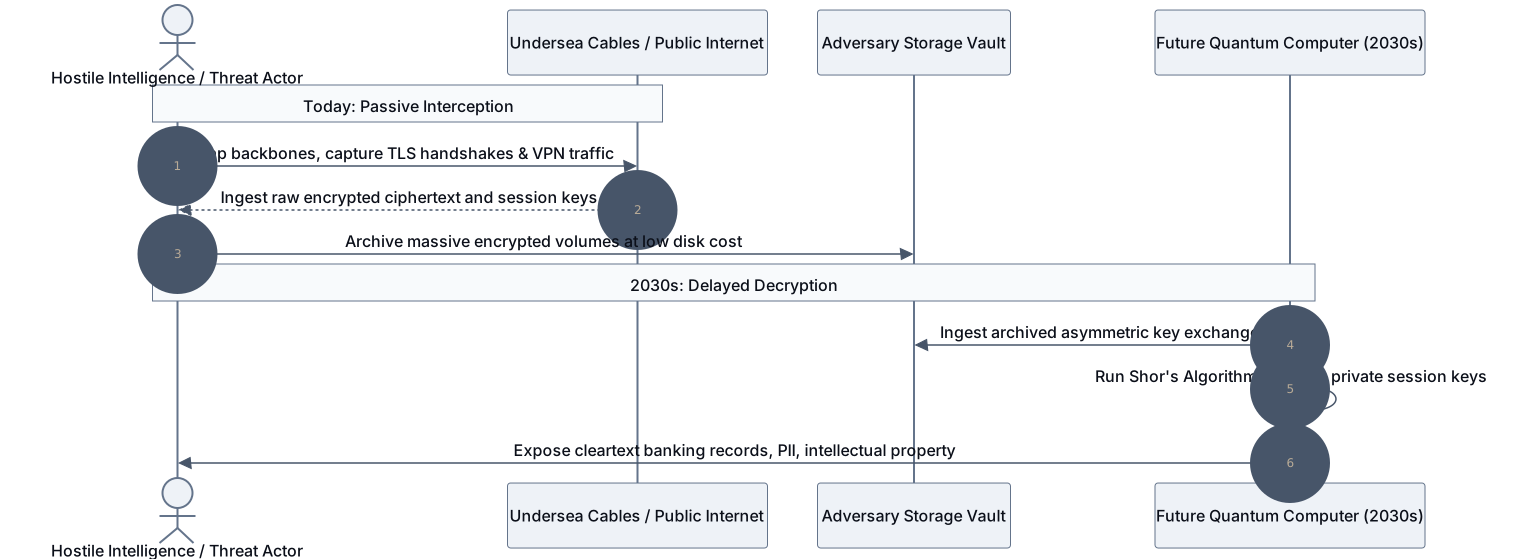
This ignores how intelligence agencies and cyber syndicates operate. This strategy is known as Harvest Now, Decrypt Later (HNDL), sometimes also called Store Now, Decrypt Later (SNDL).
The Shelf-Life Calculation #
Adversaries passively record encrypted internet traffic traversing transoceanic cables, satellite links, and compromised routing points, storing it in low-cost vaults. When a Cryptographically Relevant Quantum Computer (CRQC) comes online in the 2030s, they will feed these archives into Shor’s algorithm to decrypt the payloads.
To determine your immediate exposure, evaluate three variables:
- Data Shelf-Life (X): How many years must your data remain confidential? (e.g. 10 years for banking data, 25 years for proprietary patents, 30+ years for medical and government records).
- Migration Time (Y): How many years will your organisation take to discover, refactor, and deploy new cryptography across your applications and infrastructure? (Typically 3 to 7 years).
- Quantum Horizon (Z): How many years until adversaries deploy a functional quantum computer? (Estimated at 6 to 10 years).
If Data Shelf-Life (X) + Migration Time (Y) > Quantum Horizon (Z), your data is already exposed.
Consider a practical scenario: If you are a financial institution that must keep customer transaction records protected for 10 years, and you estimate it will take 5 years to migrate your entire technology stack to become quantum-resistant, you are operating on a 15-year security requirement. If a capable quantum computer emerges in 2030, any protected traffic captured across public networks today will be decrypted long before that 15-year window closes. In this scenario, it is already too late to prevent retroactive exposure: your current live data is effectively already sitting in adversary vaults waiting to be unlocked.
What Changes? Replacing Vulnerable Algorithms #
Not all cryptography fails against quantum machines. The impact depends on whether the algorithm is symmetric or asymmetric.
ALGORITHM RESILIENCE IN THE QUANTUM ERA

[ASYMMETRIC KEYS: BROKEN BY SHOR'S ALGORITHM]
- RSA (Key exchange & signatures)        --> Completely Insecure
- ECDSA & Ed25519 (Digital signatures)  --> Completely Insecure
- Diffie-Hellman & ECDH (Key exchange)   --> Completely Insecure
- Action: Must be replaced with lattice-based algorithms

[SYMMETRIC KEYS & HASHES: RESILIENT AGAINST GROVER'S ALGORITHM]
- AES-128                                --> Deprecate (Effective strength halved)
- AES-256                                --> SECURE (Maintains 128-bit quantum security)
- SHA-256 / SHA-384 / SHA-512            --> SECURE (Collision resistance holds)
- Action: Enforce AES-256 across all storage and transit

[NEW POST-QUANTUM STANDARDS (NIST FIPS)]
- ML-KEM (FIPS 203)                      --> Replaces ECDH / RSA for Key Exchange
- ML-DSA (FIPS 204)                      --> Replaces RSA / ECDSA for Signatures
- SLH-DSA (FIPS 205)                     --> Replaces Code Signing & Root CAs
Architectural Challenges: Larger Keys and Network Overhead #
Post-quantum algorithms use lattice mathematics, which requires significantly larger keys and signatures than compact elliptic curves:
- Key Growth: A classical X25519 public key is 32 bytes. An ML-KEM-768 key is 1,184 bytes. An ML-DSA-65 signature is 3,309 bytes (compared to 64 bytes for ECDSA).
- Packet Fragmentation: A post-quantum TLS handshake exceeds 8 KB. Because standard ethernet Maximum Transmission Unit (MTU) limits packets to 1,500 bytes, handshakes split across multiple TCP segments. Legacy firewalls and middleboxes that mishandle fragmented handshakes can drop connections.
- Token and API Bloat: JSON Web Tokens (JWTs) signed with post-quantum keys expand from 300 bytes (0.3 KB) to 4,500 bytes (4.5 KB), representing a 15x increase in data size that adds bandwidth and latency overhead to high-frequency microservice API calls.
The Practical Defense: Hybrid Cryptography & Cryptographic Agility #
You do not need to replace your entire technology stack overnight. The industry standard defence focuses on two practical engineering patterns:
1. Hybrid Key Exchange (Dual-Keying) #
Leading web browsers, edge networks, and security libraries have deployed hybrid key exchanges (combining classical X25519 with post-quantum ML-KEM-768).
A hybrid handshake generates two shared secrets and combines them using an HMAC-based Key Derivation Function (HKDF). To decrypt the session, an adversary must break both classical math and lattice math. Enabling hybrid key exchange on your edge load balancers immediately stops HNDL interception for current web traffic.
2. Cryptographic Agility #
Organisations must build cryptographic agility: structuring software and database schemas so algorithms, key lengths, and certificates are configurable parameters rather than hardcoded assumptions. Abstract cryptographic functions behind modular libraries and ensure database columns accommodate larger post-quantum keys.
Regulatory Momentum Across APAC #
Governments and financial regulators across the Asia-Pacific region have issued directives preparing critical sectors for post-quantum migration:
- Thailand (BOT & NCSA): The Bank of Thailand and National Cyber Security Agency emphasise algorithm lifecycle management and transit payload security across financial operators, supported by regional awareness initiatives highlighting post-quantum readiness.
- Singapore (MAS): The Monetary Authority of Singapore Advisory on Quantum Cybersecurity Risks directs financial institutions to conduct cryptographic inventories, evaluate third-party dependencies, and trial hybrid post-quantum protocols.
- Australia (ASD / ACSC): The Australian Signals Directorate Post-Quantum Cryptography Guidance outlines planning steps for critical infrastructure entities to identify vulnerable public-key systems and transition to NIST-approved standards.
Executive Action Checklist #
- Audit High-Value Data Flows: Identify systems transmitting long-retention records (financial histories, customer PII, trade secrets) vulnerable to HNDL.
- Enable Hybrid PQC on Edge Gateways: Configure reverse proxies, API gateways, and web application firewalls to negotiate hybrid
X25519 + ML-KEMcipher suites for TLS. - Enforce AES-256: Upgrade legacy AES-128 configurations to AES-256 across all data storage and internal communication tunnels.
- Demand Vendor Roadmaps: Require core banking, HSM, and enterprise SaaS providers to present formal post-quantum migration schedules.
Where to Go From Here #
- Audit your cryptographic posture: Schedule a Configuration & Architecture Assessment to locate hardcoded ciphers and unencrypted hops across your environment.
- Verify data in transit: Read our guide on Data in Transit Protection: TLS, VPNs, and Internal Networks and review our API & Application Security Review.
- Align with regional standards: Ensure your cryptographic roadmap satisfies regulatory requirements with our Regulatory Compliance Advisory.