
- Complete Security, Delivered with Accountability/
- Security Insights & Advisories/
- Third-Party Risk Management for APAC Enterprise/
Third-Party Risk Management for APAC Enterprise
Table of Contents
The modern organisation is not a single company; it is a web of vendors, SaaS platforms, cloud providers, and integrators, each holding a thread of your data and your reputation. When one of them fails, you inherit the failure: the regulator asks you why the vendor was vetted, and the customer asks you why their data leaked through a supplier you chose.
Third-party risk management (TPRM) is the discipline of making that web legible: knowing who has access to what, how much you depend on them, and whether their controls actually hold up.
The questionnaire trap #
Most TPRM programmes are a spreadsheet of 200-500 questions sent to every vendor, then filed and forgotten annually. This produces paperwork but very little risk reduction, for two reasons:
- It treats every vendor equally. A coffee supplier and a payments processor get the same questionnaire, despite wildly different exposure.
- It trusts self-attestation. A vendor that says “yes, we encrypt data” is not the same as one that can show it. Questionnaires measure confidence, not controls.
The fix is proportionality and verification. Categorise vendors by the access they actually have, then spend deep-dive effort where the exposure is real.
Tiering by actual exposure #
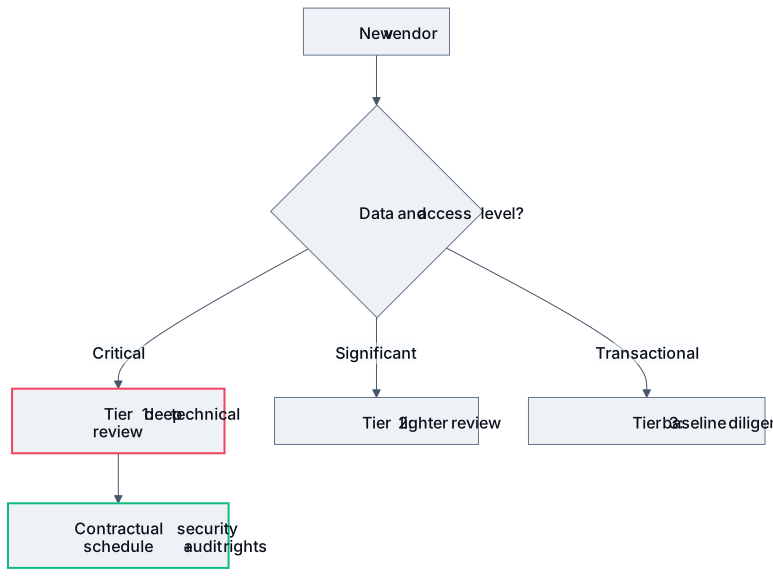
A workable model tiers vendors by what they touch:
- Tier 1, critical: hold cardholder or personal data, integrate deeply with your systems, or are a single point of failure. These get technical assessment, audit rights, and contractual security schedules.
- Tier 2, significant: process business data or have privileged access. These get a lighter technical review and periodic re-validation.
- Tier 3, transactional: limited or no data access. These get baseline due diligence and nothing more.
The point is not more process; it is proportionate process. A Tier 1 payment gateway that fails is an incident. A Tier 3 stationery vendor that fails is an inconvenience. Treating them the same wastes effort on the wrong risk.
Beyond the questionnaire: technical verification #
For the vendors that matter, self-attestation is not enough. Technical verification means asking for evidence and, where the relationship justifies it, testing:
- Evidence review: SOC 2 reports, ISO 27001 certificates, PCI DSS AOCs, and, critically, the scope of those reports, not just the logo.
- Architecture review: how the vendor actually handles your data in their environment, not how their marketing page describes it.
- Contractual teeth: enforceable security schedules, breach-notification timelines, and audit rights that survive renegotiation.
The frameworks agree on this. NIST SP 800-161 on supply chain risk, and ISO 27001’s supplier security clauses (A.15 in the 2022 edition’s mapping), both push toward proportionate, evidence-based vendor assurance rather than blanket questionnaires. Bank of Thailand outsourcing guidance applies the same logic to financial institutions and their critical vendors.
Continuous, not one-off #
Vendor risk is not static. A vendor that passed review last year can be acquired, breached, or quietly change their sub-processors this year. The mature model re-validates on a risk-based cycle, monitors for signals (data breaches, ownership changes, certificate lapses), and has an offboarding path that actually revokes access, not just cancels the invoice.
Our Third-Party Risk Management builds the tiering model, runs the deep-dive reviews, and drafts the contractual security schedules your legal team needs. Pair it with Regulatory Compliance to map vendor obligations to BOT and ISO 27001 requirements.